Signed in as:
filler@godaddy.com
Purpose
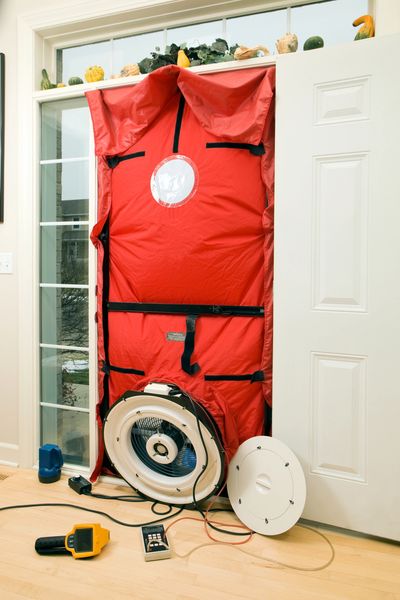
A blower door test is used to measure how airtight a building is—basically, how much air leaks in and out through cracks, gaps, and poorly sealed areas.
How it Works
A temporary frame with a calibrated fan is sealed into an exterior doorway. Exterior doors and windows are closed, interior doors are opened. Combustion appliances are set safely so nothing backdrafts. The fan creates a standard pressure difference—usually 50 pascals, about the force of a 20-mph wind hitting the building. Sensors measure how much air the fan has to move to maintain that pressure. More airflow = more leaks.
Air Exchanges Per Hour
How many times the entire volume of air inside a building is replaced in one hour due to air leakage. If a house has an ACH50 of 3, it means that when the house is at a test pressure of 50 pascals the equivalent of all the air inside the house leaks out and is replaced 3 times in one hour.

Purpose
When testing a home’s energy efficiency, an infrared (thermal) camera works by detecting heat coming off building surfaces and turning it into a visual mat of temperature difference. This lets inspectors see energy problems that are invisible to the naked eye and can see where energy is being wasted.
How It Works
Everything in a home—walls, ceilings, windows, ducts—emits infrared radiation based on its temperature. Warmer surfaces emit more infrared energy. Cooler surfaces emit less.
The camera’s sensor measures infrared energy across thousands of points and converts it into a color-coded image: Warm areas appear as brighter or warmer colors. Cool areas appear as darker or cooler colors. These patterns show temperature differences across surfaces.

LiDAR is 3D information about the roof and its surroundings.that lets us figure out how much solar energy the roof could receive. It comes from a laser scanning system—usually on a drone, plane, or satellite—that measures distances very precisely. The result is a point cloud: millions of tiny 3D points representing: Tree's, chimneys, antennas, surrounding buildings, etc.
Azimuth is the compass direction a surface faces. This can impacts how much energy a home uses.
South-facing roof (~180° azimuth)
East-facing roof (~90° azimuth)
West-facing roof (~270° azimuth)
Azimuth is the compass direction a surface faces. This can impacts how much energy a home uses.
South-facing roof (~180° azimuth)
East-facing roof (~90° azimuth)
West-facing roof (~270° azimuth)
North-facing roof (~0° azimuth)
Radiance tells us how much sunlight energy is traveling toward a specific part of the roof from every direction. By calculating radiance from the sun, sky, and reflections, solar software can determine how much energy a roof acurately receives throughout the day and year.